

Career Growth
Google, IBM, and Whole States Dropped the Degree Requirement. The Data Says Something Uncomfortable.
By JC de las Alas, Founder and Lead Instructor
· 7 min read
For decades, a four-year degree was the invisible ceiling over the job market. No diploma, no interview, no matter what you could actually do. That ceiling is finally cracking, and some of the biggest names in the world are the ones swinging the hammer.
Google now treats its own online career certificates as the equivalent of a four-year degree for related roles (CNBC). IBM cut the degree requirement from about half its US job openings and champions skills-first "new collar" hiring (Fortune). Whole US states have followed: Maryland dropped four-year-degree requirements for thousands of state jobs (The Washington Post), and Pennsylvania announced that 92 percent of its state jobs no longer require a degree (Commonwealth of Pennsylvania), with Utah and others close behind (Higher Ed Dive).
It sounds like the paper ceiling is gone. The data tells a more complicated, and more useful, story.
The ceiling really is cracking
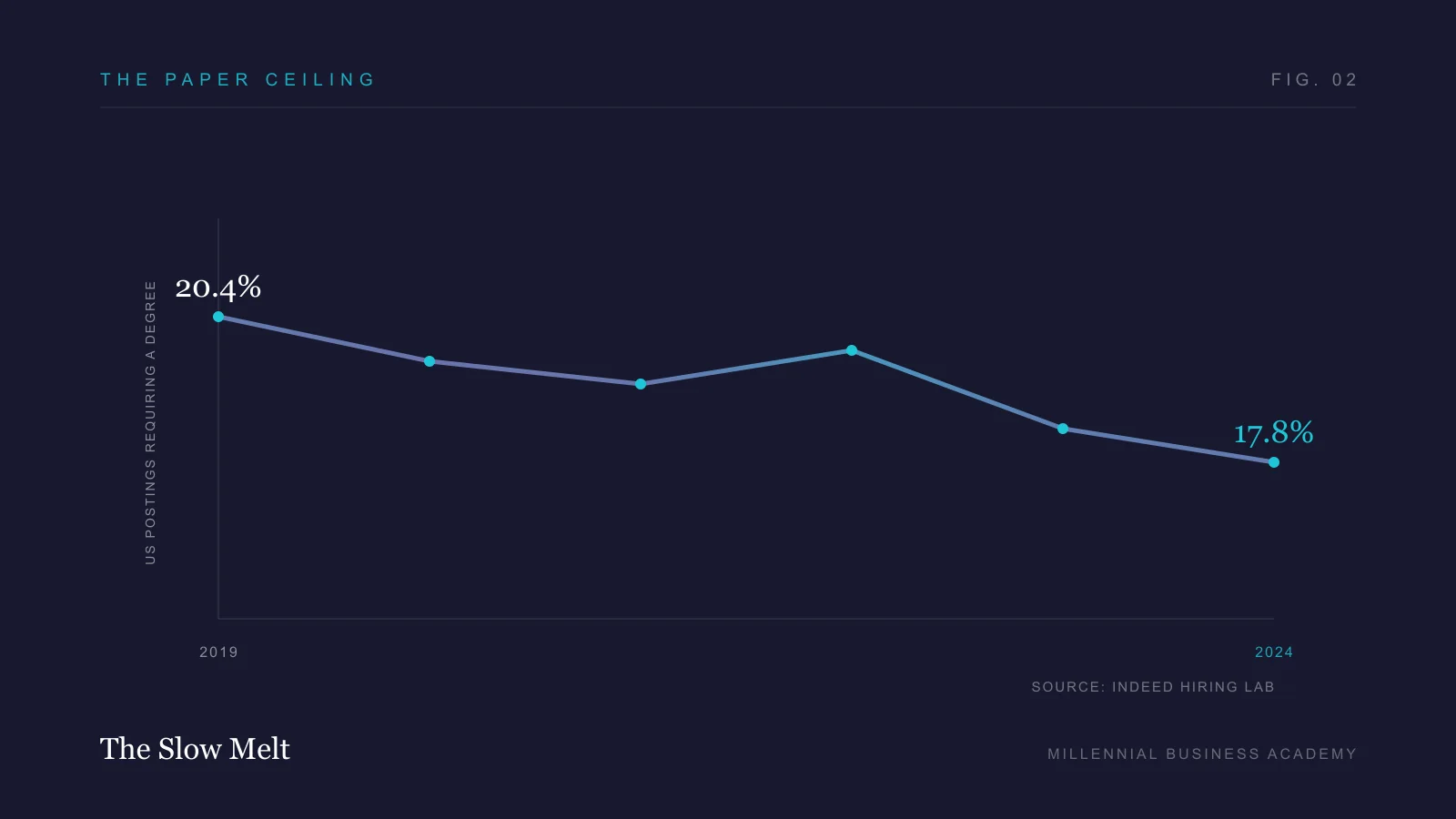
This is not just press releases. In actual job postings, degree requirements have been quietly melting. According to Indeed's Hiring Lab, the share of US job postings requiring at least a bachelor's degree fell from 20.4 percent in 2019 to 17.8 percent by early 2024, with degree mentions dropping across the large majority of job categories (Indeed Hiring Lab).
Why now? Partly a tight labor market, partly a growing pile of evidence that the degree screen was never a great filter in the first place. A Harvard Business School study called it "degree inflation": employers demanding a bachelor's for jobs that never used to need one, then finding that experienced non-degree workers performed just as well, while degree-holders often cost more and left sooner (Harvard Business School).
The uncomfortable catch
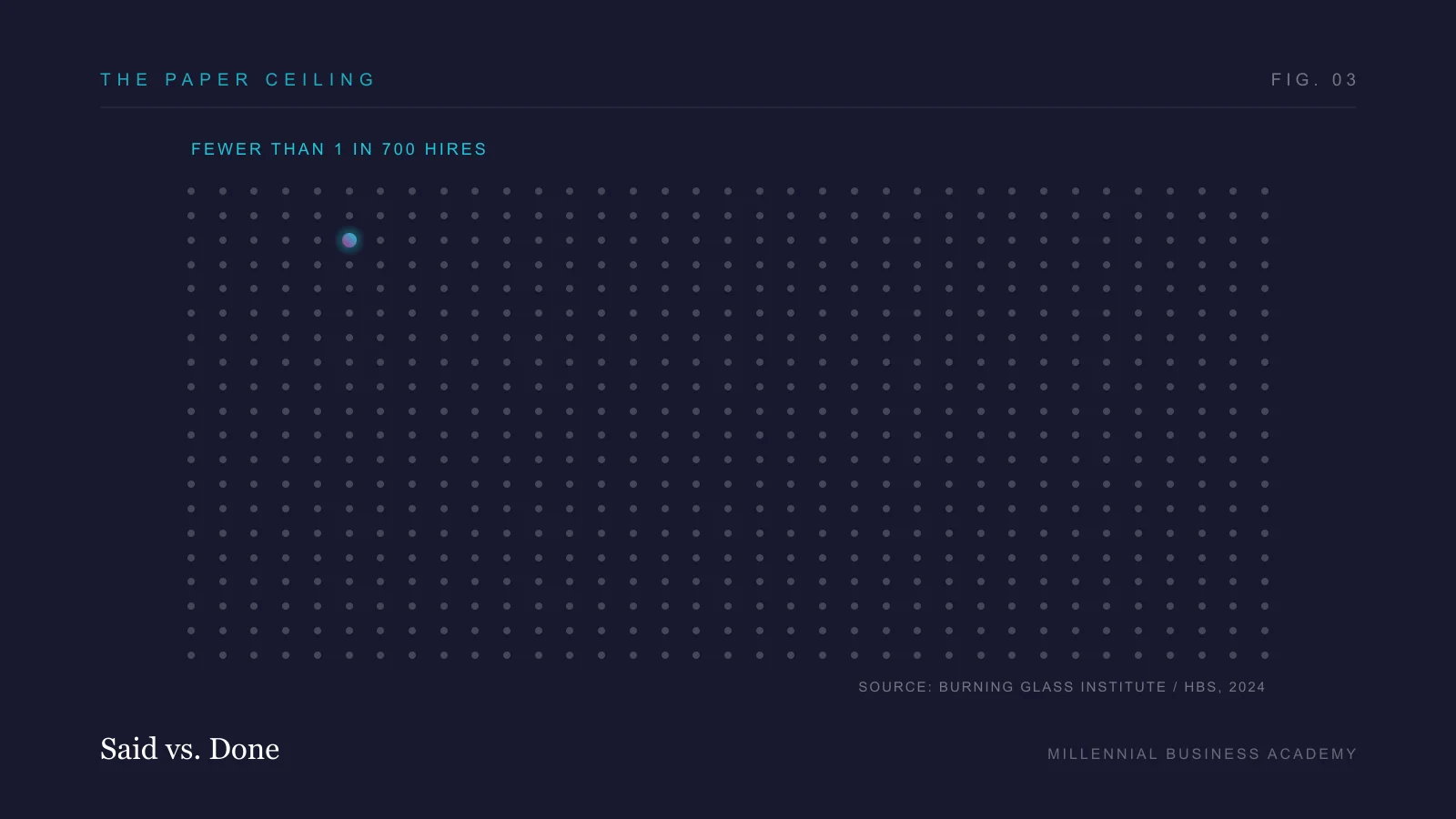
Here is where you should pause before celebrating. A follow-up study from the Burning Glass Institute and Harvard looked at what companies actually did after announcing they were dropping degree requirements. The gap between the press release and the payroll was staggering: despite the announcements, fewer than 1 in 700 hires in 2023 actually benefited from a dropped degree requirement (HR Dive).
In other words, the door is being unlocked, but most people are not walking through it yet, because many employers changed the posting and not the habit. The researchers sorted companies into genuine reformers, "in name only" adopters, and even a group of backsliders who quietly reversed course (Burning Glass Institute).
What this actually means for you
It would be easy to read that and feel cheated. Do the opposite. That uncomfortable data is the most useful career advice you will get this year, and it points to one thing: proof beats permission.
If the degree no longer opens the door by itself, and the "we dropped the degree" promise is only half-real, then the thing that gets you hired is undeniable evidence that you can do the work. Not a certificate you can claim. Work you can show.
- Build a portfolio, not just a resume. Two or three real projects, a dashboard, an automation, an analysis, prove more than any line on a CV. They are the skeleton key for a job market that no longer trusts the diploma alone.
- Speak in outcomes. "I cleaned a messy sales export, found the errors, and rebuilt the report" beats "I have a certificate in data analytics" every time.
- Target the genuine reformers. Employers and roles that truly hire for skills exist and are growing. Aim there, and let your work do the talking.
- Learn skills that produce proof. Choose things that end in something you can show: data analytics, AI tools, automation, a simple site or app.
For a concrete starting point, see the in-demand skills for 2026, and the step-by-step way to become a data analyst with no experience and a real portfolio.
The ceiling is cracking. Bring proof.
A world that hires for skills instead of pedigree is a fairer world, and it is slowly, unevenly arriving. But fairness does not install itself. The people who win in this new market are not waiting for permission, or for the last employer to update its policy. They show up with work in hand.
That is exactly what Millennial Business Academy was built to produce: not just certificates, but portfolios, real and provable skills for Filipinos the old system overlooked. If you want a place to begin building your proof, start with the free training.
- #Career Growth
- #Upskilling
- #Hiring
- #Opinion
Frequently asked questions
Publicly reported examples include Google, which treats its career certificates as equivalent to a degree for related roles, and IBM, which removed the degree requirement from about half its US openings. Several US states, including Maryland, Pennsylvania, and Utah, have also dropped four-year-degree requirements for most state jobs.
Increasingly no, but it depends on the employer and the role. Degree requirements are fading in job postings, yet studies show many companies announced changes without changing who they actually hire. The most reliable way in is a portfolio of real work that proves you can do the job.
It is real but uneven. Job postings requiring degrees have declined, but a 2024 Burning Glass Institute and Harvard study found fewer than 1 in 700 hires in 2023 actually benefited from dropped requirements. Genuine skills-first employers exist and are growing, so target them and lead with proof of your work.
Build undeniable proof: two or three real projects you can show, described in terms of outcomes rather than credentials. Focus on skills that produce visible results, like data analytics, AI tools, and automation, and apply to employers that hire for skills.